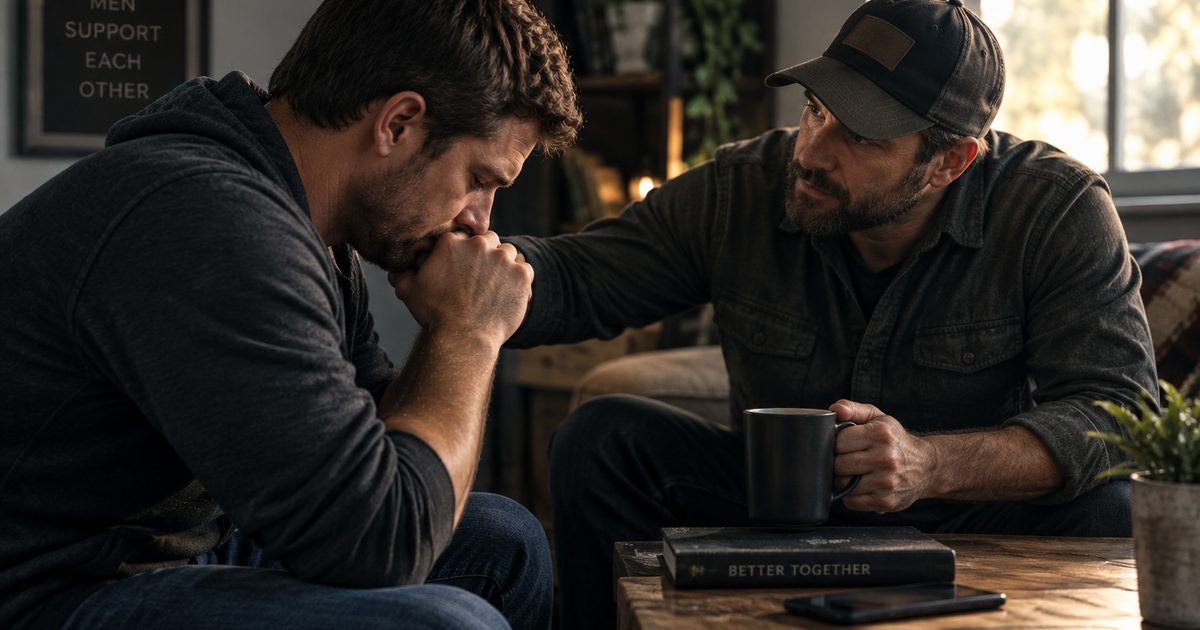
Somewhere along the way, "accountability partner" became the standard advice for men quitting porn — and, in church circles, for any man struggling with lust. And somewhere along the same way, most accountability quietly stopped working. Two guys agree to "check in." An app emails somebody a report nobody reads. A weekly coffee turns into a ritual: "How was your week?" "Rough." "Mine too." "I'll pray for you." Both men fall again by Friday.
I had versions of that for years while my addiction stayed fat and comfortable underneath it. I've also had the real thing, and the real thing was one of the main reasons I got free. The difference isn't how hard the two men are trying. It's how the thing is built.
Why most accountability fails
Most accountability is built as a confession system. Its only real moment comes after a fall, when there's something to admit. That design fails for a simple reason: it aims at the wrong moment. By the time there's something to confess, the battle is over. And because every check-in is an autopsy, the whole relationship starts to run on shame. You soften the reports, then skip a week, then the thing dies of embarrassment.
Working accountability is a contact system. Its main moment comes before and during the danger, not after. The single most useful sentence in my recovery wasn't "I fell on Tuesday." It was a text that said: "I'm in a bad spot right now. Talk me through the next twenty minutes." In my experience, an urge builds, peaks, and eases within minutes rather than hours — often inside ten or twenty — which is what makes it something you can plan around (that rise-and-fall is the idea behind urge surfing). A phone call during those minutes beats a confession after them.
A referee shows up after the play to announce what went wrong. An ally shows up during the play. Recruit an ally.
Who to ask
Three qualities matter more than anything else. Safe: he can hear the whole truth without flinching, gossiping, or turning it into a sermon. Steady: he'll actually answer the phone at 11pm, and he'll still be doing this in month six when the novelty is gone. Honest: you're not looking for a man you'd hate to let down, because shame-based accountability collapses exactly when you need it most. You're looking for a man you can tell the truth to on the worst day. That's the only day accountability matters.
A man in recovery himself is often the best fit. He needs no explanations, and his house has glass walls too. In my experience, mutual accountability, where you hold each other's, tends to outlast the one-way kind. If no one in your life fits, that's what recovery groups are for. Every man in the room is there for the same reason, and our resources page and guide for Christian men both point to good ones. One honest caution: your wife cannot be your accountability partner. She can know everything — she should — but making her the person who monitors your recovery hands her a job that hurts her twice.
What to actually ask for
The ask, in plain words
"I'm quitting porn, and I need one person who knows the whole truth. I'm not asking you to check up on me. I'm asking for permission to contact you when I'm in trouble, before anything happens. And I want to do a short honest check-in once a week. Would you be that person?" Most men are not burdened by this ask. Most are honored by it. And in my experience, more often than you'd expect, the answer includes "me too."
The two agreements that make it work
The flare: a text or call during the urge, with an agreed response. He calls back, or replies, and talks you through the wave. To make the flare easy to send, agree on a simple signal in advance. Even a single word works.
Make the flare easy to send
The free Crisis Toolkit walks you through an urge in real time, and its Reach Out step has a pre-written message you can copy and send to your partner in two taps. No account, no email.
Open the Crisis ToolkitThe weekly truth: ten minutes, three questions, no softening. How were the urges? What was the closest call? Is there anything you're not telling me? That last question is the one that keeps secrecy from growing back. Answer it honestly, week after week, and the hiding has a much harder time getting its grip again.
If you fall
Tell him the same day. Not to be judged — that's the referee model — but because telling him fast is what keeps one bad hour from souring into a lost week. A fall doesn't end the partnership. Hiding it is what ends it. The men who last are the ones whose falls stop being secrets within the hour. More on the first 24 hours after a relapse.
Stay on the road
Walk it with us.
Occasional emails for the long road — honest, practical, never explicit.
No spam. Unsubscribe in one click. Emails arrive with neutral subject lines — how we protect your privacy.